If you imagine accounting a few years ago, the vision of physical books or basic items of the table is coming to mind. Today we are entering a bold new era where accounting develops from simple automation to autonomous finance itself. The future of AI bookkeeping is not only about reducing manual work but about transforming accounting into a separate intelligent system.
From Automation to Autonomy
First, businesses accepted automation: replacement of recurring items, reconciliation of statements, generating invoices, and detection of anomalies using the rules based logic. But it was just a gate. Another wave is based on decision making automation. Software not only performs tasks, but decides which tasks should be done, when and how.
This shift leads us to autonomous finance, to an area where your accounting system monitors cash flow, predicts narrow streams, recommends actions and even performs certain financial strategies – without human intervention. It’s no longer “set and forget” – it’s “set smart and let it run.”
What Enables the Leap?
This transformation rests on three core pillars:
- Predictive AI
- Self-learning models
- Next gen fintech infrastructure
Let’s explore each other.
- Predictive AI
Traditional accounting is reactive: you record what happened. Predictive AI seizes systems to predict what happens. For example, based on historical sales cycles, seasonal trends, and external data (market indices, macroeconomic signals), the intelligent system can estimate the future tides of cash.
In practice, predictive modules will warn you that your account receivables are tightening for two weeks, or that you should postpone certain expenses to avoid deficiency. This prediction is central to the future of AI bookkeeping, allowing financial teams to remain proactive, not only react.
2. Self‑Learning Models
Predictive power is only as good as the models behind it. Self-learning models (or adaptive) are constantly adapting new data before they require manual retraining. If your income flow changes because of a new product or market shift, the software forces its internal weights and recalibrates predictions.
Over time, these models grow more tuned to your business patterns-inquiry, one-time events, irregular expenditures-and they become smarter in identifying opportunities and risks. Combined with automation of decision making, self-learning models drive autonomous finance forward.
3. Next‑Gen Fintech Infrastructure
All modeling in the world is unnecessary if your systems can’t talk to each other. Another wave of accounting depends on:
- APIs that link banking, payroll, payment platforms and ERP modules
- Secure cloud architecture providing real time data flows
- To the design of the baked built in matches and audit trails
This next gen fintech allows intelligent accounting software to act quickly and the conditions when they guarantee conditions, while maintaining transparency and compliance.
Intelligent Accounting Software: The Core of the Future
Let’s talk about the software itself – the core of this transformation is intelligent accounting software, a kind that simply records items, but reasons, forecasts and behavior.
Key skills you will see:
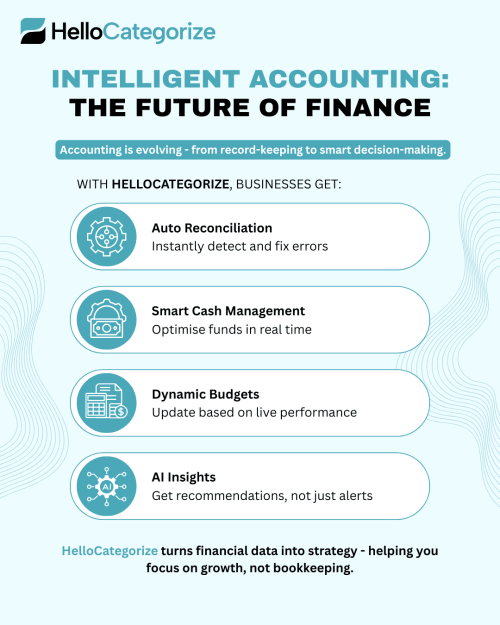
- Autonomous reconciliation: The system detects discrepancies and solves separately
- Managing Intelligent Cash: Software moves funds between accounts or investment means to optimize revenues or liquidity
- Strategic budgeting: Budgets develop based on real -time performance, not static tables
- Adaptive notifications and recommendations: You just don’t get warnings but are conducted by specific actions
Self service audit trails built in Audit protocol
One of the real references in this space is HelloCategorize, a platform created for intelligent categorization and interpretation of financial data. By analyzing transaction formulas, HelloCategorize reduces the burden of manual classification and allows businesses to focus on knowledge rather than accounting.
How Autonomous Finance Changes Roles and Responsibilities
Once accounting machines become smarter, the role of human accountants and the shifts of a financial professional. Instead of entering data or chasing invoices, they will become architects of supervision, strategies, and guardians of integrity.
Where once you verify numbers, you’ll now audit the decision-making automation behind them. Once you enter line items, you know the rules and Prague curate. This shift increases financial teams to strategic partners, rather than back work.
Obstacles and Considerations
Of course, this transition is not without challenges:
- Data quality: Autonomous systems strongly depend on clean and complete data
- Confidence and interpretability: The creators of the decision must trust by model decision; Transparency and Explainability are essential
- Compliance with regulations: Autonomous measures must meet accounting standards, tax law and audit requirements
- Security and privacy: Financial data is sensitive; Robust encryption, controls of permits and audit protocol
- Cultural Adoption: Teams must adapt to assignment of intelligent systems that may feel uncomfortable at first
However, it is not a showstopper, just an area for which it is necessary to plan. As the software ripens, these concerns are solved through hybrid supervision models, explained AI, secure APIs, and gradual introduction.
What the Future Holds
Look forward:
The future of AI bookkeeping is one in which human intervention is only needed for our strategy of the edges, not daily drudgery.
Autonomous finances will be expanded to be a book – a prognosis into tax, orchestration of compliance with regulations and a financial scenario simulation.
Intelligent accounting software is inserted in depth into intelligent ecosystems – for example, launching public procurement approval, negotiating the terms of the supplier, or automatically optimizing working capital.
FINTECH Players will provide the plugin modular systems, which means that even small businesses can join autonomous financial building blocks without a massive direction.
In short: Accounting ceases to be a burden. Instead, your financial systems will become the agent’s active collaborators in the growth of your business.
Frequently Asked Questions
What exactly is “autonomous finance”?
Autonomous finance refers to systems that not only automate accounting tasks but also decide. For example, cash assignments, paying payments, recommending modifications without human entry, led by predictive and spontaneous models.
How does predictive AI differ from traditional bookkeeping software?
Traditional accounting is purely reactive; you will notice what has already happened. On the other hand, predictive AI enjoys the basis of patterns and external signals, allowing you to anticipate the needs of cash flows, risks, and opportunities before taking place.
Are self-learning models safe to trust?
Yes, provided they are designed with transparency, audit trails, and the possibility of rewriting a person. Self learning models can be highly reliable, but supervision is still necessary, especially during the time of early deployment.
What kinds of businesses can benefit from intelligent accounting software?
Virtually, all scalable businesses from small and medium sized enterprises to large corporations are beneficial. The greater the volume and complexity of the transaction, the greater the value comes from autonomous abilities.
How is HelloCategorize relevant in this context?
HelloCategorize is an example of intelligent accounting software that automatically helps categorize financial transactions. Its recognition of patterns helps to reduce manual classification and release sources for tasks with higher value. In future systems, platforms such as HelloCategorize will be fed into larger autonomous frames.