Understanding the Two Approaches
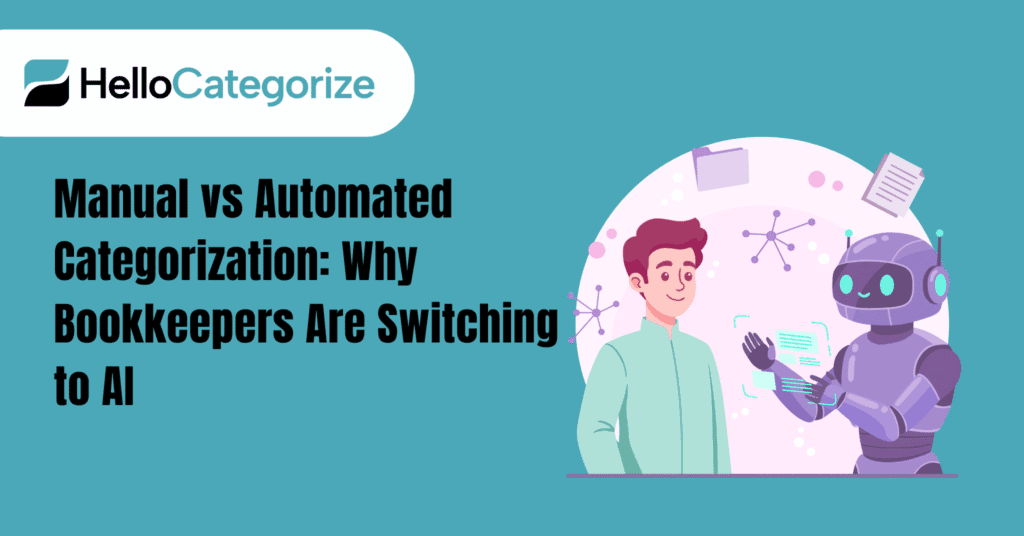
Manual categorization is what every business used to do where a human reviews transactions, interprets the data and codes it to a chart of accounts. This method utilizes the skill, discretion and background knowledge a bookkeeper knows to apply to uncertain entries. Auto-categorization also referred to as categorization assistant, financial data transaction entries are automatically categorized by rule-based filters and some form of reinforcement learning based on machine learning. The goal of both methods is to create financial records in some form of organized structure, but the philosophy behind them is completely unique.
Strengths and Weaknesses
Manual classification is ideal when transactions are not common, require context and judgment or should represent detailed business decisions. An experienced bookkeeper can notice discrepancies, infer from incomplete descriptions and use judgment around one-offs.
However, manual effort is time-consuming, error-prone and not scalable. Monotonous jobs generate both exhaustion, and inconsistent tagging wrong among team members. Discrepancies due to inconsistency in the classification of items may be identified during audits and reconciliations.
The rule application method of automated categorization with its scalability is fast. It will save you time by taking the pain out of mundane book keeping, leaving bookkeepers free to concentrate on higher value work like analysis, advisory services and anomaly identification. The trade-off is that automation can mislabel outlier cases when the producing model has not received enough training data, or new business operations are not reflected in an updated set of rules.
Why Bookkeepers Are Switching to AI-Driven Categorization
Learn why bookkeepers and accounting teams are now favoring machine learning-based and intelligent rule-driven automated categorization for a number of practical purposes.
- Efficiency and Time Savings
Automated systems can handle thousands of transactions in the time it takes a human to do a few. This efficiency decreases backlog, shrinks monthly close cycles and cuts labor costs from manual, repetitive categorization.
- Consistency and Standardization
Automated requires that categorization rules are applied consistently between teams and over time periods. Consistent reporting and budgeting reports are more credible along with forecasted numbers due to the fact that financials all follow consistent classification logic.
- Faster Error Detection
More specialized models trained on normal patterns can also flag outliers and potential errors with far greater speed. Rather than the manual scouring of records, bookkeepers now look at flagged items—cutting down on time reconciling.
- Scalability for Growing Businesses
The volume of transactions for a business tends to be nonlinear as their size grows. Programmable ledger scales not keeping pace with staffing, so bookkeeping can keep up to business.
- Better Use of Human Expertise
When rote categorization is automated, bookkeepers can focus more on strategic work — say variance analysis, internal controls or advisory services that add more value to clients or stakeholders.
Practical Considerations for Adoption
The transition from manual to automated categorization is not a flip of the switch. Bookkeepers can take a systematic approach to adoption, to avoid upheaval and yield benefits.
Start with Hybrid Workflows
A hybrid process — in which automation is used for clear cases while people review ambiguous or high-value transactions — offers an orderly way to make that shift. This is how bookkeepers will be able to vet the automated decision, train the system, and gain trust in its outputs.
Train and Tune the System
Autocategorization gets better with good training data, and continuous tuning. Train the system on labeled historical transactions to learn typical patterns. You should periodically monitor and address misclassifications so your model will adjust to changing business operations.
Maintain Clear Rules and Overrides
Automation needs to come with strict guidelines for when we use a machine. Bookkeepers need to be able to bypass automated rulings and explain their actions so that decisions can be examined by auditors or review panels.
Monitor Data Quality
The quality of clustering is a function of the quality of input data. Promote vendor naming and reliable invoice description conventions, as well as clean imports. Low quality input data can lower the automation performance and lead to wrong classification.
Addressing Common Concerns
The automation of bookkeeping is putting many accountants on edge that there will no longer be a place for human expertise. In fact, automation changes the job rather than eliminating it. Bookkeepers are the keepers of truth, serving as exception managers, model stewards and forward looking counsels.
And so do data privacy and control. Bookkeepers need to be certain that by using an automated approach, data access control remained being respected, audit trails and decision history can be logged in order for the team to trace and explain categorization.
Then there is the danger of over-reliance. Automation is the aid, augmenting judgment rather than replacing it. Internal reviews, reconciliations and spot checks on a regular basis maintain the system’s integrity.
Best Practices for Successful Implementation
- Pilot on a subset of accounts: Use repeatable transaction types and low risk accounts to evaluate effectiveness and tune rules.
- Keep human review for exceptions: Setting up threshold levels can automatically accept while exceptions are transactions within confidence limits which do not fall in criteria as defined respectively by the organization.
- Documentation of workflows and updates: Clear documentation can enable teams to onboard new members and also support auditing requirements.
- Set up regular model evaluations: Regular checks make sure the system stays relevant with seasonality, vendor changes or new business lines.
- Educate staff on exceptions: Provide bookkeepers with guidelines for processing misclassifications and recording their corrective actions.
The Bottom Line
This is important when dealing with complex or ambiguous cases where human judgment is helpful. But the expansion of automated classification isn’t being spurred purely by pure digital-age wastefulness; there’s also some real efficiency, standardizability, and scalability involved. With a practical, hybrid approach and an emphasis on ongoing fine-tuning, bookkeepers will be able to leverage automation to free themselves from routine work (aiding accuracy in the process), allowing them more time for high-value financial matters. The move to intelligent categorization is a reflection of an industry in-transition—one where human wisdom and machine speed combine together to produce superior financial results.
Frequently Asked Questions
What is automated categorization for bookkeeping?
Automated categorization uses algorithms and learned patterns to assign transactions to accounts, reducing manual effort and improving consistency.
How can bookkeepers transition from manual to automated categorization?
Bookkeepers can adopt a hybrid workflow, provide training data, set clear override rules, monitor data quality, and periodically evaluate system performance.