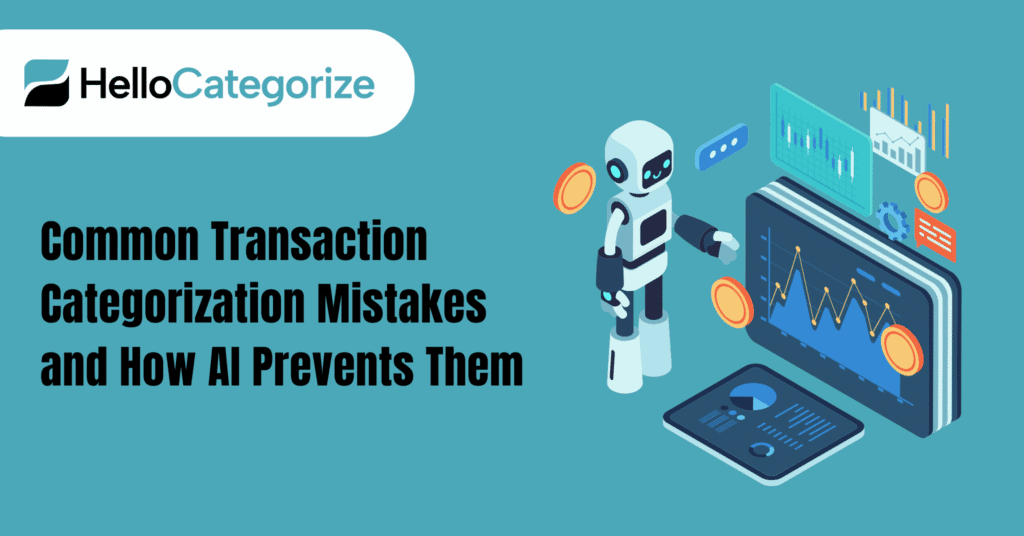
The appropriate sorting of transactions is critical for financial understanding. Whether it is accounting, budgeting expense reports or compliance calculations by identifying what each transaction is you can ensure consistent analytics and easy reconciliation. But the real killer for a lot of firms is maintaining accurate, consistent classifications that so many downstream issues arise – such as errors and wasted time or lack of confidence in reports. This article points out common transaction categorization issues and how the solution can help correcting these errors, improving accuracy and scaling your bank statement classification process.
Why accurate categorization matters
Correct categorization converts raw transaction data into useful information. Correctly categorized transactions lead to accurate P&L reporting, efficient budgeting, automated approvals and tidy audit trails. Inaccurate or inconsistent categories slow down your team with misleading reports, increasing reconciliation time and more manual work fixing errors. And knowing typical failure modes can help identify remedies.
Common transaction categorization mistakes
Over-reliance on rigid rule sets
Many rely on hand-crafted rules — if “merchant” contains X, tag Y; if amount matches pattern, tag Z. Rules are brittle. They break when merchants are renamed, descriptions change or new types of transactions appear, resulting in misclassified or missed updates.
Ignoring ambiguous or minimal descriptions
Transactions often include brief, cryptic descriptions — codes, truncated merchant names or internal numbers. Searching for literal text matches and/or simplistic pattern-matching methods can ignore context and may assign incorrect categories.
Duplicate and split transactions
Refunds, partial refunds, split payments and card-authorisations can result in multiple associated entries that are processed separately. Systems that don’t recognize relationships might also double-count, mislabel or be unable to link refunds back to originals.
Manual corrections without feedback loops
This is because when human operators fix categories, but those fixes are not used to update rules or models, the errors repeat. No learning and inefficiency from corrections mean manual work becomes repetitive.
Inconsistent merchant naming and mapping
Merchant names differ based on acquirer, region or transaction source. Manual mapping tables age fast, resulting in different labels for the same vendor.
Failure to detect anomalies or unusual items
And nonrecurrences Rare and high-value transactions and one-off vendor names can be mischaracterized because they deviate from typical patterns. Without anomaly detection, these transactions pass through unscathed.
How AI prevents common categorization mistakes
AI ameliorates a good many of these failure modes, by generalizing from examples, by learning patterns and adjusting over time. Here are some specific ways in which AI enables better categorization.
Natural Language Understanding for ambiguous descriptions
AI models based on natural language processing can process short, noisy descriptions more effectively than exact-match rules. They derive merchant names, transaction purpose, and contextual information to make the best guess even when textual data is partial or shortened.
Pattern recognition across fields
AI can use several transaction attributes together — description, amount, date, merchant ID and country — to decide if it’s a particular type of payment. This multi-field approach also ensures that accuracy is increased by avoiding errors in a single field and when processing complicated transactions.
Duplicate and relationship detection
Machine learning algorithms identify evidence of refunds, reversals or split payments by finding links in amounts, dates and identifiers. It also avoids to double count and give same label to related entries.
Continuous learning from corrections
When human correction is recorded and fed back to models, AI gets better. Supervised learning and active learning pipelines correct mislabels to refine classifiers, gradually decreasing repetition of the same mistakes and manual effort.
Merchant normalization and fuzzy matching
In place of static mapping tables, AI allows for fuzzy matching and normalization to align variations in merchant naming. This eliminates duplicate entries in the author index, and to prevent multiple formats for the same vendor.
Anomaly detection and confidence scoring
AI models can even surface low-confidence classifications and outliers. If necessary, transactions with anomalous patterns or low confidence scores can be routed for human review, directing attention where it is most needed while automating routine matters.
Explainability and audit trails
Recent AI can offer explanation or value of the features for why a classified decision was made. Transparent explanations and audit trail enable easier reviewing, explaining and refining of categorizations for compliance and trust.
Practical steps to implement AI-driven categorization
Start with good training data
Gather data from normal (and edge) casesés. Ad corrected categories from previous manual work. Quality labels are more important than massive amounts of noisy data.
Combine rules with models
Hybridize by using simple deterministic rules for the easy cases and AI models for ambiguous or hard ones. Rules can process exceptions quickly, and models handle the variability.
Build feedback loops
Capture human corrections and feed them into regular retraining rounds. Track model metrics and monitor drift in order for the system to accommodate new merchants and transaction types.
Define confidence thresholds and review flows
Specify confidence thresholds for auto-categorization. If a transaction is low-confidence it should be marked for human review. However, as the model becomes more and more accurate, we can move thresholds out to pull in more unsafe (but really safe) scenarios that would make things down the road safer.
Monitor key metrics
Keep records of track accuracy, false positive/negative rates, review volume and time spent correcting. Tracking these KPIs provides a rational for investment and drives ongoing improvement.
Ensure governance and transparency
Keep a log of classifications and corrections. Define document categories and update what decisions are approved so your accounting and compliance team can confirm those actions.
Conclusion
Transaction categorization errors are easy to make but easy to correct, too. Transitioning from rigid, rules-based AI to the AI-augmented can better manage vague descriptions, merchant variations, refunds or anomalies. When applied in conjunction with practical governance of machine learning—training data, feedback loops, confidence thresholds, and monitoring it can help organizations to reduce manual work, increase the accuracy of reconciliation and generate trustworthy financial insights. By thoughtful implementation, AI will become a tool to prevent mistakes, not introduce new ones — one that allows teams to trust their financial data.
Frequently Asked Questions
What are the most common causes of transaction categorization errors?
Common causes include rigid rule sets, ambiguous or truncated descriptions, inconsistent merchant naming, duplicate or split transactions, and lack of feedback from manual corrections.
How does AI reduce the need for manual corrections in transaction categorization?
AI uses natural language understanding, pattern recognition across multiple fields, merchant normalization, and continuous learning from corrected labels to improve accuracy and reduce repeat manual fixes.