Why multi-client bookkeeping increases burnout risk
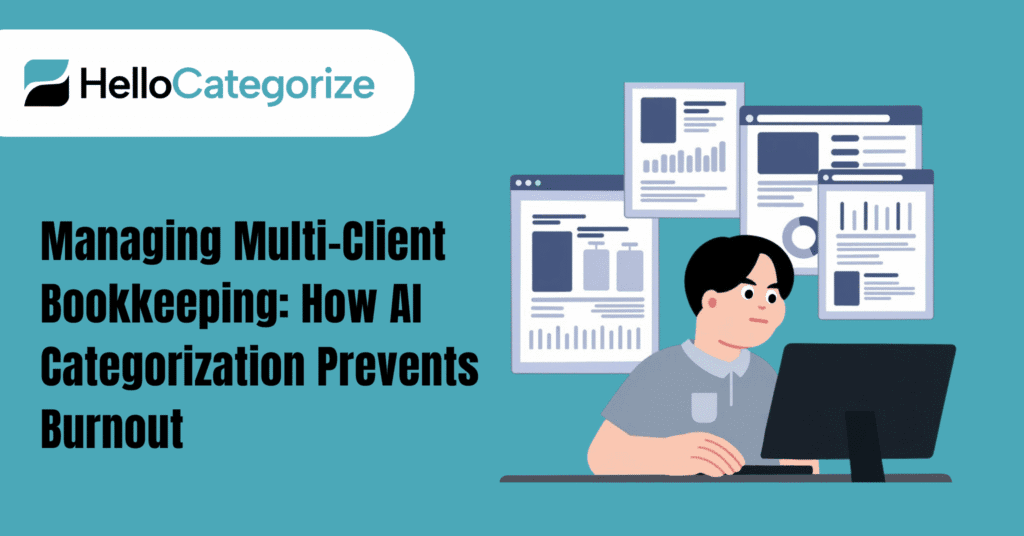
Bookkeepers who deal with multiple clients will be under other kinds of pressures too: diverging chart of accounts, non-uniform labeling, client expectation differences and an endless cascade of transactions to reconcile. The eccentricities of each client — a special category required, a quirk in the way invoices are done, an unfinished source document — pile up as cognitive overhead. Continuously switching between client-side rules and finance mechanics is mentally exhausting and time consuming on every day tasks. Over months, this friction leads to longer hours, more errors and finally burnout.
With AI-powered transaction categorization, however, that can change. When applied judiciously, AI removes repetitive decision making, ensures compatibility across clients and liberates bookkeepers to think about exceptions, advisory work and improving processes instead of groaning under the weight of manual categorisation.
How AI categorization works in bookkeeping (overview)
Movements detection AI categorization is enforcing patterns and rules on past transactions in order to automatically fill new ones. On the most basic level, it takes in labeled examples — previous transactions already categorized by human bookkeepers — and uses those patterns to sort new transactions. It is capable of handling discrepancies in vendor names, invoice descriptions and amounts and flag ambiguous cases for human review. Instead of substituting for judgment, AI is an assistant that does predictable categorization at scale.
Core benefits for multi-client workflows
- Consistency: AI uses consistent categorization logic among similar transactions and between clients as much as is possible to minimize differences that need correction later.
- Time: Group processing of regular items saves hours a day/week corresponding with your books, particularly for high transaction volume clients.
- Focus: With the grunt work out of the way, bookkeepers spend their time focusing on reconciliations and exceptions, as well as client-specific advisory items that require human understanding.
- Scalability: The same categorization system applies to a larger number of clients without really increasing the mental load.
Practical steps to implement AI categorization without losing control
To avoid creating new stress, plans must be made if AI categorization is to be used. Take these pragmatic measures to enhance value, while preserving accuracy and reliability.
1. Standardize client onboarding and chart of accounts
Go back to basics: perfect this and then layer on AI via a structured onboarding checklist and a common chart of accounts (CoA template) feed that can be adapted by client. Uniform labeling and categorization support the ability of AI systems to learn patterns while reducing the number of edge cases users must manually manage.
2. Start with a training set of high-quality labeled transactions
AI is only as good as its examples. Gather a sample of typical transactions for each client including key suppliers and recurring items. Accurate labeling at this stage is crucial; noisy or conflicting tagging will train the system with incorrect rules and lead to increased review overhead later.
3. Define rule-based guardrails and review thresholds
And onto this apply simple rules (i.e., require human review of all transactions above a certain dollar amount, for vendors not in the system or rarely seen, when AI confidence score is low). These guardrails help to avoid expensive misclassifications and keep bookkeepers in the loop for major decisions.
4. Batch review and exception handling
Make time to look at a batch of transactions the AI reviewed, don’t always check individual transaction constantly. Batching minimizes context switching and preserves deep work hours. Establish an efficient workflow of exceptions: all flagged items should be funnelled to a single reviewer or small group, in order to avoid redundancy.
5. Continuous feedback and retraining
Incorporate feedback into the daily routine. When a bookkeeper corrects a category, that correction should be fed back into the system so the machine learns to do better predictions in the future. Retrain models or refresh rule-sets from recently corrected data — this process is iterative and error rates and review assignments decline over time.
6. Transparency and explanation
Employ systems that gives explanations why they suggest something: a vendor match, similar past transaction or maybe rules applied. Once bookkeepers understand why the categorization was suggested, they can have more confidence in the system and override it less.
Managing the human side—communication and workload design
AI saves humans from having to do repetitive work but still requires human oversight. Address human factors explicitly to avoid burn-out during and after AI adoption.
- Role clarity: Redefine roles such that routine categorization should be the part of unexceptionable automation (i.e., almost everything except for humans solving reconciliations, exceptions, training data quality, and client communication).
- Schedule time: Dedicate focus work times to batch reviews and deep reconciliation tasks to reduce interruptions and context switches.
- Instruction: Train on how to interpret the AI’s suggestions and use the review tools effectively. Confident, comfortable users who are getting their work done faster will make better decisions.
- Client expectations: Outline for clients the gains in accuracy and speed. Establish expectations for when human review is applied and exceptions are made.
Measuring success and preventing new problems
Establish specific benchmarks to know whether AI categorization is truly lowering burnout risks and increasing workflow efficiency.
- Time per client, period: Calculate the number of hours used on basic categorisation pre vs post implementation.
- Misclassification rate: Percentage of songs that are misclassified and must be corrected manually.
- Review volume: Keep track of the number of transactions being flagged for human review and what’s triggering that.
- Employee satisfaction: Periodically poll bookkeeping employees on workflow, context switching, and stress.
Leverage these numbers to tweak thresholds, retrain models, or improve onboarding processes. If the volume of reviews does not drop, consider whether it is an issue with data quality or inconsistent labeling, and not about statistically poor performance of AI at all.
Final considerations
Artificial intelligence categorization is a great tool for multi-client bookkeeping it must be used with discipline. Standardize charts of accounts, curate high quality training data, set guardrails for review and provide clear workflows that eliminate context switching. Coupled with real-time feedback loops and open explanations, AI has the potential to make monotonous fielding tasks in the background — reducing error rates, shrinking hours worked and protecting bookkeepers from constant stress that can lead to burnout. The outcome is more durable workloads, better financial statements of merit and time returned to the advisory that clients value most.
Frequently Asked Questions
How does AI categorization reduce burnout for multi-client bookkeepers?
AI categorization automates routine transaction labeling, enforces consistency across clients, reduces context switching, and frees bookkeepers to focus on exceptions and advisory work, lowering repetitive strain and time pressure.
What safeguards prevent AI from introducing new errors in bookkeeping?
Safeguards include standardized charts of accounts, high-quality training data, rule-based guardrails for large or uncertain transactions, batch review processes, and continuous feedback loops to retrain and improve the system.