Good financial reporting is the foundation of good decisions. But a lot of companies roll up their sleeves and sort through their transactions by hand, which is time-consuming, error-prone and hard to scale. Robotic transaction categorization can revolutionize bookkeeping and accountancy processes by using uniform rules, machine learning models and user-configurable mappings to classify income, expenses, transfers etc.
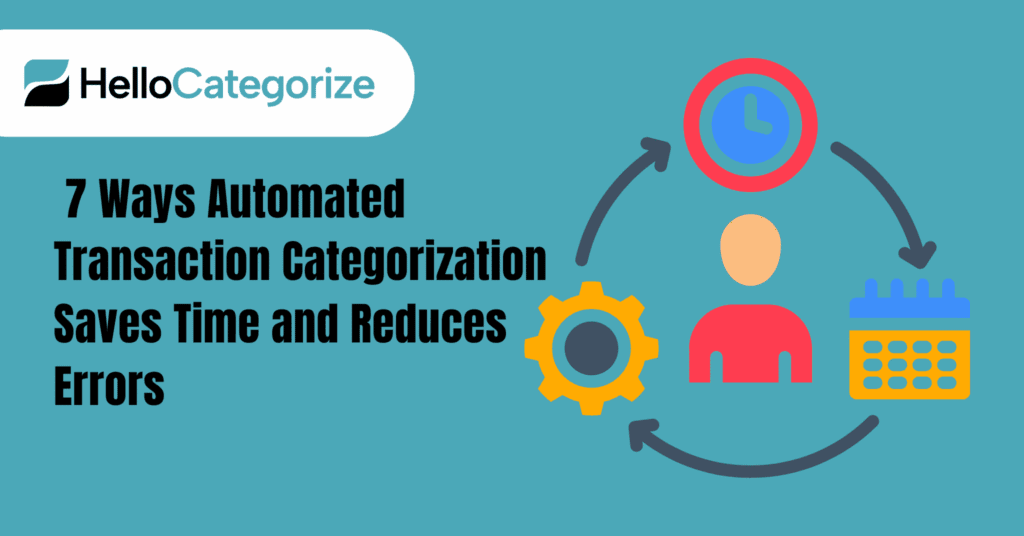
In this article, we look at seven practical reasons why automating categorization of transactions can help to save time and money as well as how users can use intelligent transaction categories implemented reliable to do quicker closes, more transparent reporting and improved control.
1. Eliminates repetitive manual data entry
Save hours on routine work
Amongst the immediate gains of automation is it’s ability to do away with mundane processes. Promote : Instead of a finance person reviewing the same set of vendors, or expenses categories week after week, automatic categorization applies established rules to automatically assign categories in-app. That cuts down the amount of time users spend on data entry each day, and frees up accounting teams to do more analysis, reconciliations or strategic work.
2. Ensues consistent categorization rules
Reduce human variability
Human classification can differ by individual, day, or interpretation of the policy. Computerized systems apply standard rules to all transactions, which minimizes variations in entries in the ledger. At month to month, it means the reports can compare cleanly with each other (month after month), tax classes will be stabilized, and audit explanations related to variances are less involved.
3. Accelerates month-end and close processes
Faster reconciliations and reporting
Reconciliations are much faster if transactions are coded properly, and handling is smooth. Automation groups such transactions like alerts sales reps of which ones don’t adhere to expected patterns, and flags exceptions automatically. And that enhances the team’s capability to deliver statements on time.
4. Reduces classification errors with intelligent matching
Use patterns and learning to improve accuracy
Automation can identify transactions that do not fit into set patterns or rules. These oddities could signal an error, a double charge, fraud or an unusual business event. When you shed light on exceptions, rather than forcing your staff to examine every single line item, automation supports a way of working centered on addressing the real problems rapidly.
5. Improves detection of outliers and anomalies
Proactive error identification
Transaction volume spirals out of control as companies scale. Headcount is required to scale for manual categorization, whereas automated workflows can accommodate larger datasets without a commensurate increase in labour. That makes growth more sustainable, and keeps overhead predictable, while preserving data quality.
6. Enables scalable workflows for growing transaction volumes
Scale without proportional headcount increases
As businesses scale, the volume of transactions can shoot up. There isn’t the headcount to scale manual categorization but automated processes can accommodate greater datasets without a corresponding linear increase in labor. That makes growth more sustainable and maintains some predictability of overhead while preserving the quality of data.
7. Enhances downstream accuracy for analytics and tax reporting
Better inputs yield better outputs
Accurate classification drives all downstream processes: budgeting, forecasting, tax return preparation and management reporting. With reliable categories in place, financial models become more dependable and tax preparers can have faith in consistent classifications. This cuts down on the time you waste scouring data and defending category decisions during reviews.
Best practices for implementing automated categorization
Start with a clear chart of accounts and consistent naming
Great automation relies on clear input. Establish what the logical chart of accounts look like and establish naming conventions for vendors and expense types sot rules can be stright from the get go.
Combine rule-based logic with review loops
Start with easy rules for high volume, low variance transactions and layer in pattern based matching for the more challenging ones. Keep a light human-in-the-loop review loop of exceptions for the system to learn from, and continue to increase the accuracy as more humans use it.
Maintain an exceptions workflow
No amount of automation will ever completely rule out the ambiguous transaction. Add a exceptions queue that sends unrated items to someone with context plus some suggested categories for quick resolution.
Monitor accuracy and refine rules regularly
Track quality assessment criteria and spot check a proportion of automatic assignments from time to time. Utilize this knowledge to tune rules, extend match patterns and eliminate false positives.
Document changes and maintain audit trails
Maintain a record of rule changes, overrides and reviewer activity. Documentation can feed audits as well and provide a clear trace of why classification decisions were taken.
Getting started: practical steps
- Chart the highest occuring types of transactions and get at those first. Apply rules to the most popular groups for best time saving.
- Automate the pilots with few accounts or one entity at a time to confirm their accuracy.
- Educate reviewers on the exceptions workflow and how to teach the system, by correcting categorizations.
- Calculate ROI by quantifying how much time is saved as well as error rates and the reduction of exceptions.
Conclusion
Automatic transaction classification makes accounting easier, more consistent and less error prone. By removing the repetitive manual entry, enforcing consistent rules and acceleration of monthly-end processes for more scalable operations, automation lets finance teams spend less time on fixing data — and more on analyzing it. When done well, with clearly defined rules and an exceptions process, automated categorization becomes a force multiplier—increasing accuracy across reporting, analysis, and compliance while saving precious staff time.
Frequently Asked Questions
What is automated transaction categorization?
Automated transaction categorization applies rules and pattern matching to classify financial transactions automatically, reducing manual entry and improving consistency.
How does automation reduce errors in bookkeeping?
Automation enforces consistent rules, uses historical patterns to match transactions, and flags anomalies for review, which reduces misclassification and speeds reconciliations.