In an increasingly complex and fast financial environment, businesses are no longer limited to any entity or geography. Modern businesses operate across several legal entities, departments and sectors, each of which performs thousands of financial transactions every day. The classification of these transactions is exactly and consistently critical, but incredibly demanding. This is where the scalable classification of AI becomes necessary to achieve efficiency, accuracy and control in the classification of multiple enthusiasm.
Complexity of Transaction Management with Multiple Entities
Businesses that manage multiple business units or subsidiaries face significant obstacles in terms of classification of business transactions. Each unit can observe unique accounting standards, use different cost codes, or rely on local financial teams. As a result, achieving consistent and accurate multi-entity categorization becomes a logistical nightmare, often leading to discrepancies, reporting delays, and operational inefficiencies.
Manual processes cannot handle the scale. Finance teams often must deal with:
- Irregular data across units
- Time consuming verification
- Delay in financial closure
- Errors in consolidated messages
When assortment breaks down, it impacts not only the ledger, but also decision making, compliance, and investor confidence.
Why Traditional Methods Weaken
Many organizations still rely on old methods like spreadsheets, manual entry, or rule-based classification scripts. These methods may work on a small scale but deteriorate rapidly under the pressure of large volume processing and multi-unit operations.
The problems with traditional approaches include:
- Lack of scalability: Manual classification cannot keep up with the growth of transactions.
- Invisible logic: different teams interpret categories differently, leading to inconsistency of reporting.
- High errors: Human supervision leads to incorrectly classified expenditure and risks of compliance.
- Delayed report: Closing the Moon at the end is delayed due to time consuming classification.
For companies aiming for efficiency, there is a need for a more dynamic and integrated system, one that supports enterprise transaction categorization at scale and across all entities.
The Role of Scalable Categorization AI
In order to deal with these challenges, more organizations turn to a scalable AI range. It is a powerful technology that automates transaction classification using artificial intelligence. The analyzation of historical data sales and payments, AI can accurately assign categories with minimal human intervention.
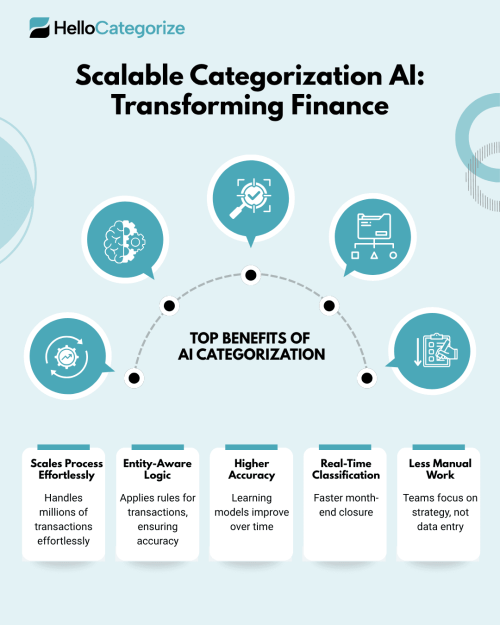
Benefits of Scalable Categorization AI:
- Effortless AI Processing at Scale: AI smoothly processes millions of transactions while supporting a high growth environment.
- Logic Awareness of Entity: The system can apply different classification rules for each entity and ensure compliance with regulations without sacrificing consistency.
- Improved accuracy: For learning models that constantly specify predictions, accuracy has improved over time.
- Real time classification: transactions are immediately classified, allowing faster closure at the end of the month.
- Less manual interventions: Financial teams can focus on exemption management and strategic supervision, not data entering.
Large-Volume Processing Demands Scalable Solutions
Businesses with volumes of high transactions require scalable solutions designed to process a large amount of processing in the system. Data currents flow from all directions from platforms for awarding public procurement and wage systems to ERP and banking channels.
A scalable categorization solution must:
- Integrate with different data sources
- Normalize transaction data formats
- Apply intelligent classification model
- Scale dynamically as business grows
Such systems ensure that the assortment keeps a step with business activities rather than becoming an obstacle to financial operations.
Centralized Expense Tracking: A Strategic Imperative
Effective centralized expense tracking is one of the most important results of enterprise-wide classification. Without it, CFOs and finance leaders struggle to get a unified view of where the money is going and why.
If the scalable category AI is applied across the organization, then:
- Costs are continuously monitored in all organizations
- Financial knowledge is available in real time
- Discrepancies, fraud or incorrect allocation are detected quickly
- Budgeting and prognosis improve with accurate data
This level of visibility is not just an advantage for reporting, but it is a strategic advantage. Companies that maintain centralized control over expenditures make faster and more informed decisions and reduce financial risk.
Choosing the Right Solution: HelloCategorize
For businesses prepared to simplify their efforts to categorize business transactions, platforms, such as HelloCategorize, provide a purpose full solution for modern financial teams. HelloCategorize uses scalable AI categorization to automate transactions across multiple entities, systems and geographical areas.
With features like:
- Classification AI controlled more entity
- Treatment of high volume transactions in real time
- ERP platforms and accounting and accounting platforms hassle free
- Centralized panel for monitoring expenditure and exemption management
HelloCategorize brings scalability, accuracy, and transparency that modern businesses require. This emphasizes financial teams to reduce manual workload, accelerate closing cycles, and obtain complete control of their transactions.
Transitioning to AI-Driven Categorization
Implementation of scalable categorization AI does not require complete overwork. Many solutions are modular and can be integrated into your current ecosystem. Start by identifying where your classification process ends. From there:
- Map your sources of transactions across entities
- Define standard and custom categories according to business unit
- Train your AI model using historical data
- Set verification rules and workflow for exceptions
- Follow the results over time and improve accuracy
The transition to the categorization of multi-some-driven AI is a strategic investment that quickly pays off in savings, accuracy and operating dexterity.
Conclusion
Financial operations of modern enterprises require more than human efforts and old equipment. As the volumes of transactions increase and business structures become more complex, organizations need intelligent and scalable systems to remain under control.
Scalable AI categorization allows companies to automate, standardize and streamline their efforts to categorize business transactions across all entities. With the right technology established such as Hellocategorize. Businesses can ensure accurate reports, reduce financial risk and achieve real centralized cost monitoring.
Now it is time for the visionary financial leaders to accept scalable solutions created for reality of operations with multiple units. Result? Higher efficiency, transparency and strategic clarity throughout the company.
Frequently Asked Questions
What is multi-entity categorization, and why is it important?
Multi-entity categorization refers to the precise classification of financial transactions into different business units or subsidiaries. This is important to maintain consistency in reporting, ensure compliance, and support consolidated financial analysis across large enterprises.
Why do traditional classification methods fail in large enterprises?
Traditional methods such as spreadsheets and manual rules lack scalability, are prone to human error, and cause delays in financial reporting especially in environments that deal with large amounts of processing across multiple entities.
How does scalable categorization AI improve financial processes?
Scalable categorization AI automates transaction classification, applies entity-specific rules, improves accuracy over time through machine learning, and reduces the need for manual intervention. This ensures consistent, real time classification even at scale.
What are the key features to look for in a categorization platform?
Key features include support for multi-entity categorization, real-time processing, seamless integration with ERP/accounting systems and centralized dashboard for expense tracking and exception management.
How can HelloCategorize help my business with transaction categorization?
HelloCategorize offers an AI-driven, scalable solution tailored to enterprises. It automates classification across entities, supports high transaction volumes, integrates with your finance tech stack, and provides full visibility and control over expense data.